Showing posts with label Conductive Hearing Loss. Show all posts

Wednesday, November 10, 2010

And We Have a Consensus

With Nolan in a cooperative mood, we set out for Buffalo Children's this morning. With the sun shining, a good night's rest, and some blatant bribery, he made it through an entire hearing test. The audiologists at WCHOB were very impressed with his skills in the booth- I don't think they see a lot of kids who have an auditory-verbal background, since listening and hearing test skills are integrated into the therapy we do with Nolan. While we are not a true AVT family (there is no actual AVT center around here), we incorporate as many of the "learning to listen" skills as we can into our therapy.

The result of the testing indicates that Nolan does NOT have a purely conductive loss. His hearing levels are currently a mixed, flat moderately-severe loss. This is fairly consistent with the most recent audiogram obtained at Buffalo Hearing and Speech Center.

Guesstimate Audiogram-
I don't really have a photographic memory.

This is good news, because it means that the sensorineural portion of his hearing loss is stable. This also means that the hearing loss detected at birth was sensorineural or mixed in nature, and not conductive. A bone anchored hearing aid is not appropriate or advisable in Nolan's case, so we can wipe that option off the table.

Unfortunately, he has lost hearing since birth. As it stands now, he cannot hear sounds softer than 60dB. All of the additional loss, however, is of a conductive nature. This means that there is a maximal point of progression, since conductive losses can only add so much to a sensorineural hearing loss.

There is a good chance that Nolan's low frequencies were a mixed hearing loss at birth (he had a 50dB loss in this region, even before he had any ear infections). The current theory is that his loss has progressed due to tympanosclerosis (thickening of the ear drum) and some stiffened middle ear bones from chronic ear infections.

We do need to get a "tune up" on his hearing aids, since they are programmed for a 30dB loss in the high frequencies and he currently has a 60dB loss in this region. The conductive portion of his hearing loss is not "fixable," since it is not due to fluid build-up or other reversible causes. Hopefully the new permanent tubes will prevent further infection and damage to his middle ear system!

Monday, November 8, 2010

Getting Ducks in a Row

Nolan's "third site" hearing test is scheduled at Buffalo Children's (WCHOB) on Wednesday. People often ask why Nolan is underamplified, and there are a few reasons for his amplification difficulties. One reason is that his hearing levels fluctuate- his high frequencies have been anywhere from mild to moderately severe (currently at moderately severe). When his hearing dips, the amplification is insufficient to get him above the speech banana in the high frequency ranges. This is the reason that he has completely lost his high frequency sounds, and can only hear them with an FM system (his aided thresholds are in the moderate range in the high frequencies).

The other reason is that part of his hearing loss may be an idiopathic conductive hearing loss. Conductive hearing losses often take more power than a sensorineural hearing loss, and the DSL programs for programming hearing aids are based on sensorineural hearing loss parameters. In other words, Nolan's hearing aids aren't programmed appropriately due to the recently discovered nature of his loss. Without aided audiograms (our current audiology clinic refuses to do them), we are not able to get his low frequencies set to the right levels.

As a recap, we have had several different results for Nolan's hearing levels. We obtained Nolan's first bone conduction scores back in May of this year (this should have been performed with his newborn ABR testing). At the age of two-and-a-half, this is what his audiogram looked like:

His air conduction scores were in the moderately-severe rising to mild category. His left ear was the better ear. His bone conduction score was a rising configuration, indicating that his cochlear (or sensorineural) loss was consistant with his newborn ABR testing.

Then we went to John Tracy, and the testing there resulted in this audiogram:

The testing obtained at John Tracy indicated a conductive loss for all frequencies below 2000Hz, and a sensorineural loss 2000Hz-4000Hz. In other words, his cochlear hearing loss is in a traditional sloping pattern. The conductive hearing loss in the low frequencies will require more power to obtain access to the speech banana. It is interesting to note that the left ear (which was mild in May) shows a moderately severe air conduction threshold, with no appreciable air-bone gap. In other words- his high frequencies have a fluctuating sensorineural hearing loss. We have seen his hearing levels go up and down in this frequency range over the past two years. His low frequencies are conductive, but relatively stable.

With such different test results, we returned to our current audiologist in Buffalo to repeat the bone conduction testing. We achieved these results:

I used the air conduction thresholds obtained in May, since we didn't get any air conduction testing run. The bone conduction testing in August demonstrated a conductive loss at 500Hz (consistent with John Tracy), and a mixed loss at the other frequencies.

With three different bone conduction results, we need to get a "referee" test to determine which is the most accurate. The audiology department at WCHOB will be running bone conduction, air conduction, and hopefully aided testing.

Hopefully, with a proper hearing loss diagnosis, we will be able to manage his amplification better and will have a clearer picture of how his hearing loss fits in with his other medical issues. Unless, of course, we get yet another "different" hearing loss picture- hopefully the WCHOB results will match the John Tracy results or the original Buffalo results. Then we can find someone to take Nolan's declining articulation scores seriously and get his amplification set to appropriate levels.

We really want to get his plurals back!

Tuesday, September 14, 2010

ENT Visit

Wiped out from running

I am not quite sure how to fit the events of yesterday's ENT appointment into one post (it should really be three separate posts), but I am going to try.

The Never Ending Ear Infection

The "gunk" in Nolan's ear was not a sign of active infection. The ENT took a look and noted the material was definitely occluding the ear canal, but the eardrum and ear canal skin looked great. There did appear to be a large perforation behind the tube. She took him back to the Big Ear Sucker of Doom and removed the gunk. She also looked at the eardrum under the microscope, and noted the tympanostomy tube was actually lying on top of the eardrum. She removed it, and the "perforation" disappeared- it was just an optical illusion cast by the shadow of the displaced tube.

I was so greatly relieved by the news of the finally-resolved infection, that I didn't notice her grabbing the pneumatic otoscope. She made a "hmmph" sound and I looked up. She looked at me and said, "Fluid."

Rats.

So the never-ending-ear-infection is gone, but a new one is starting. The left tube is starting to extrude from the other ear as well. These were intermediate-length tubes, so they should have lasted for at least a year. They lasted for about 4 months.

Surgery is scheduled for October 12 to place a fourth set of PE tubes. This time, they'll be "long-term" tubes- I suspect they will be placing "T-tubes" into his ears on this occasion. The negative of T-tubes is that they must be surgically removed. The benefit is that they will not fall out in another 3 months, so we should be able to go for a longer period of time between surgeries.

The Random Hearing Test Results

Obviously, we need to figure out what Nolan's hearing levels truly are, and why his hearing levels fluctuate so much. We also need to determine the exact type of hearing loss for each frequency. Since we have three different bone conduction results from two different sites, we are going to have a full hearing test run at Buffalo Children's (WCHOB) sometime after his fourth set of tubes is placed. This test will be used as a "referee" for all of the other tests. Unless, of course, we get a fourth result. Anyone want to take some bets?

The Whole Apnea Thing

We're quite thrilled that the central apnea has all but disappeared. Unfortunately, the obstructive apnea has only gotten worse with time, and the ENT is not pleased. The neurologist labeled the obstructive apnea as "moderate," but the ENT heartily disagrees. It is quite severe, but she believes the neurologist downgraded her reading because she doesn't want to put a C-Pap mask on a child with a recessed mid-face (the pressure of the mask would only cause more mid-face retraction as his skull grew).

While the neurologist wanted to try a few steroids to see if they would help with the apnea, the ENT was appalled at this idea. Those drugs are only used for very mild obstructive apnea- and they're only used for apnea caused by congestion. Nolan's apneas are completely unrelated to congestion (for that matter, so are his chronic ear infections).

To determine the best course of action, the ENT wants to find out why Nolan has such severe obstructive apnea. Since he's going to be sedated for the tubes on October 12 anyway, she is going to perform a flexible bronchoscopy while he's out. A scope will be passed through his airway and into his lungs to find the level of obstruction. We should find out the results on the day of the procedure, so we will have more guidance on how to treat the remaining obstructive apnea.

We are going to have a busy October, but at least we'll have a bit more information on Nolan's hearing and breathing issues!

Tuesday, August 24, 2010

Bone Conduction Hearing Test

Nolan, with balloon-cat hat and kitty face.

For a quick recap, we have a hearing test that shows a rising slope audiogram via bone conduction (January 2010 at Buffalo-BHSC) and a hearing test that shows a traditional slope via bone conduction (July 2010 at John Tracy).

Since these two test results are the exact opposite of each other, we wanted to get a third test to clear up whatever conductive component might exist to Nolan's loss. The test yesterday showed (wait for it)... a third configuration! BHSC managed to get bone conduction with masking, which means they managed to get the bone conduction scores in each ear, individually.

While I can't remember the exact numbers, he is showing something that looks like a shallow cookie-bite configuration in both ears. His bone conduction score was 25/30dBdB at 500Hz and dropped to 50dB at 1000Hz, then came back up to 40dB by 4000Hz. He was extremely reliable, so now the question arises: does he have fluctuating bone conduction levels in addition to fluctuating sensorineural levels?

Our test in January showed a conductive component, but only in the high frequencies. The test in July showed a large conductive component from 250Hz-1000Hz, with normal cochlear function in that range. The test yesterday showed a conductive/mixed component at 500Hz, but sensorineural across the rest of the testing range.

*Insert hysterical laughter*

The only thing we can be sure of is that his loss is fluctuating across all frequencies. Our audiologist is suspicious that something was missed on his CT scan- we need to take another look at his vestibular aqueducts. This is the only thing that causes an air-bone gap in the low frequencies with fluctuating hearing thresholds (the fluctuations occur when there is no fluid or infection present, so these changes in hearing level have nothing to do with his ear infections- we omitted those results). The next step is to see the ENT, to review the data and determine what to do next. This might include a FOURTH hearing test at an independent location, where we're likely to get a fourth result.

We did not do air conduction thresholds yesterday, except for a quick Speech Reception Threshold (SRT). His SRT is 55dB in one ear and 65dB in the other (my guess is that his infected ear is the one with the worse air conduction threshold).

Speaking of the infected ear, it looks pretty bad. I have to call the ENT this morning to beg and plead to get in. The amoxicillin did nothing for it, he's had it since the middle of July, and is now at risk for complications from a long term ear infection (namely, mastoiditis: something we'd really like to avoid).

Once we get the infection cleared up and talk to the ENT about Nolan's fluctuating hearing loss and random air-bone gaps that seem to shift frequencies, we'll go back to Buffalo for the air conduction scores (these are what he really hears and are in the moderately severe range).

It's really hard to set hearing aids for constantly shifting targets- our only solution may be more frequent audiological testing.

Friday, August 6, 2010

On Conductive Hearing Losses

In many cases, conductive hearing losses are caused by earwax or fluid in the ears. This condition is both temporary and easily remedied (with wax removal or pressure-equalization tubes to allow the fluid to drain).

Since Nolan was discovered to have a large conductive component to his hearing loss (the frequencies from 250Hz-1000Hz have a large air-bone gap), I have been trying to figure out what could cause this component. It is not caused by fluid, infection, or any other temporary situation. It has been there since birth, and has not improved with the insertion of PE tubes. In fact, it has only gotten worse or fluctuated over time. In addition, he has had several hearing tests with type A tympanograms (no fluid), which demonstrate a hearing loss with a clear middle ear space.

With some research via Dr. Google, I have found a few causes for air-bone gaps (conductive hearing losses) in children. They include:

  • Ossicular malformations (the middle ear bones are malformed). Nolan's CT scan at the age of six months states: "Bony ossicles are well formed. Middle ear cavities and mastoid air cells are clear." The CT scan rules out any malformation of the middle ear bones.
  • Atresia. This means the external ear canal is not formed and prevents the transmission of sound to the eardrum. Nolan does not have atresia.
  • Congenital cholesteatoma. The MRI and the CT scan did not indicate any cholesteatomas present.
  • Fixed stapes or malleus (middle ear bones). Usually identified on CT scan- Nolan's CT scan was unremarkable.
Of course, Nolan doesn't just have a conductive loss. He has a moderate sensorineural hearing loss from 2000-4000Hz. So, what could cause a congenital hearing loss consisting of both sensorineural and conductive components, which fluctuates over time?

  • Enlarged vestibular aqueducts: there is often a low frequency air-bone gap in children with EVA. Nolan's CT scan report states, however: "Vestibular aqueducts are unremarkable." So it is probably not that.
  • X-Linked Stapes with Perilymphatic Gusher. This occurs only in boys and causes a fixed stapes, which cannot be repaired because a "stapes gusher" will occur and the ear will lose all hearing. This is a mixed hearing loss profile, but is typically severe-profound (Nolan is moderately severe).
  • Otosclerosis. This is rarely encountered in children, and is extremely rare in congenital form. This is also visible on CT scan, and Nolan's CT scan was normal.
I can't really find anything else that would cause Nolan's hearing loss profile. In any case, we either have an idiopathic conductive hearing loss and an idiopathic sensorineural hearing loss, or the two are related and Nolan's CT scan or MRI failed to show the problem.

I plotted his thresholds over time, excluding any tests with middle ear pathology (all scores below are with either type A tympanograms or patent PE tubes). Anyhow, you can see the fluctuation in his air conduction scores over time- something our ENT and audiologist have never really paid attention to:

Left Ear

Right Ear

Thursday, August 5, 2010

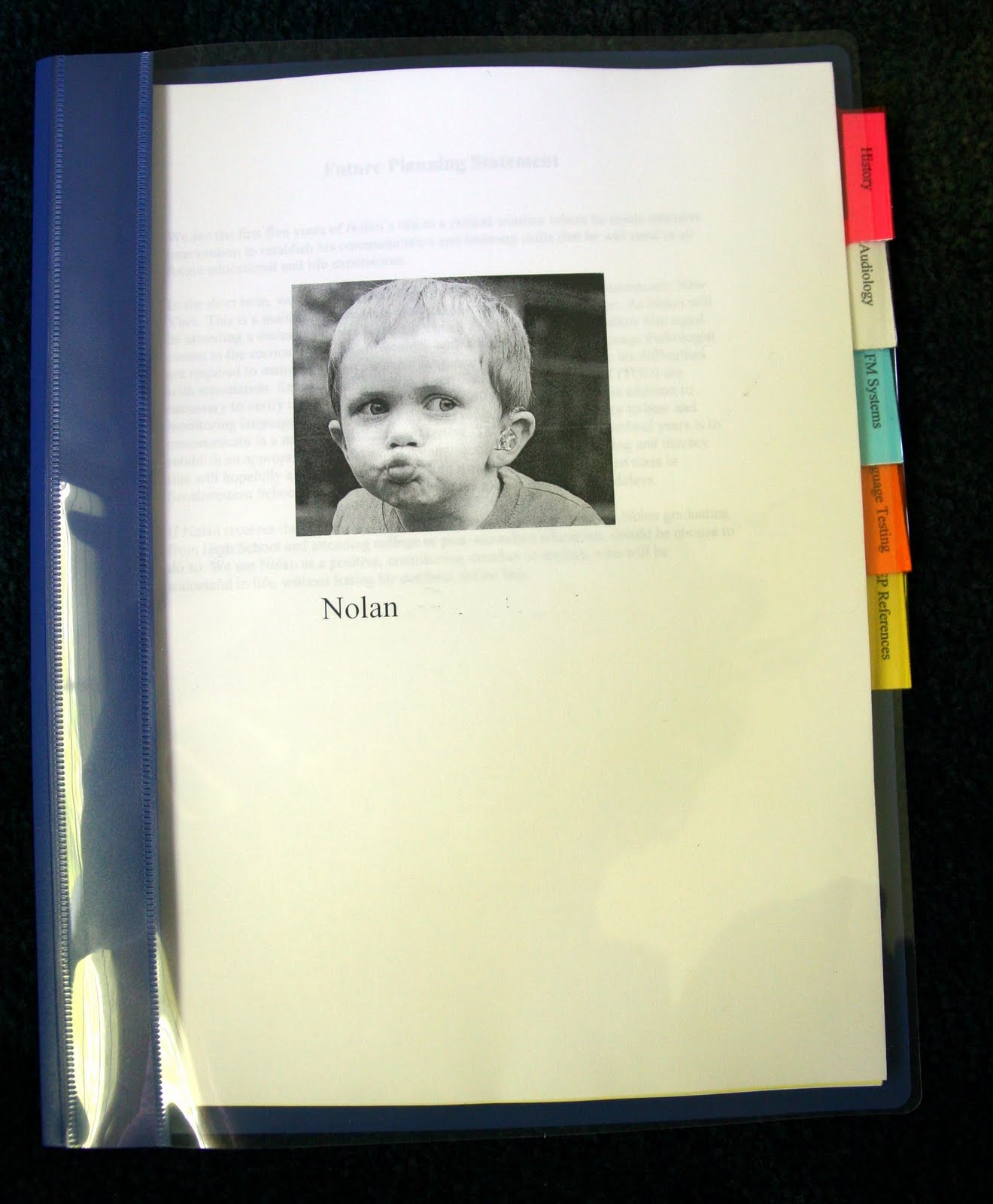
IEP Booklets

When a parent goes to an IEP meeting, it is good to have all of the proverbial ducks in a row. Know what the necessary goals and accommodations are, and have the data supporting the requested goals/accommodations at hand.

To accomplish this, we made informational booklets about Nolan's particular situation and his needs in an educational setting. The books consisted of:

  1. Nolan's name and picture, to personalize the report.
  2. Future Planning Statement.
  3. History.
  4. Audiology: all reports from birth to present.
  5. FM Systems: letter of support from our audiologist and research on personal FM systems
  6. Language testing: Testing from John Tracy and from our home Speech Language Pathologist.
  7. IEP References: this included the IEP checklist, deaf student policy guidance, essential aspects of an IEP, and Did You Know?
We made a booklet for each person present at the meeting, so everyone could have their own reference during certain discussions. These were extremely valuable during our IEP meeting- a big thank you goes out to the John Tracy Clinic and to Drew's Mom.

Tuesday, August 3, 2010

Appointments Made

Nolan's preschool class at John Tracy

I miss the John Tracy Clinic so much! They have set us on a path to figuring out Nolan's hearing loss, and for this I am forever grateful.

I called our audiology center today and made an appointment for another bone conduction test. We're going to run bone conduction first, and see what we get. Our audiologist said that sometimes there is a conductive component in children (or adults) with no identifiable etiology- in other words, we may not find a reason he has a large air-bone gap. The biggest concern is that his air-bone gap is larger than we've ever seen, indicating normal cochlear function in the low frequencies. This is completely different than any other test we've seen, so we definitely want to see if we can replicate the results. We'll see what happens on August 23rd.

I also called our ENT to make an appointment for Nolan. He has an appointment in October, and they said they could not squeeze him in any sooner than that. They did have one appointment on September 20, at 7:45am. This is definitely not ideal, since Matthew would have to miss school and we would have to leave the house at 5:45am. I told them I couldn't take that appointment- I'll find a new ENT before we have to deal with that situation. When I mentioned that I'd just go talk to his pediatrician or find another ENT because we think he's been misdiagnosed for three years, the office person changed course and said that perhaps the nurse practitioner could squeeze him in sooner. We'll see. If they don't call back tomorrow with an afternoon appointment sometime before the start of fall, then I am seeking another ENT.

Meanwhile, I am preparing Nolan's IEP information, including an entire section on FM Systems. I'm stealing ideas from the material provided at John Tracy, and from Drew's mom- who is definitely a superstar in the world of advocate moms.